Table of Contents
- Why Fake Turquoise Is Everywhere
- The Scratch Test: Your First Line of Defense
- Visual Inspection of Color and Matrix
- How to Test Turquoise with Acetone
- Stabilized vs Natural Turquoise: Know the Difference
- What Is Block Turquoise and Reconstituted Stone
- Surface Texture, Weight, and the Feel Test
- Identifying Plastic and Resin Imitations
- Frequently Asked Questions
Last Updated: August 31, 2026
How to spot fake turquoise jewelry is one of the most pressing questions for anyone shopping for authentic western wear. The market is flooded with counterfeits, and knowing the difference between genuine stones and imitations can save you hundreds of dollars. At Barrels and Bourbon Trading Co, we're sharing our expertise to help you become a savvy buyer.
Why Fake Turquoise Is Everywhere
The turquoise market faces a fundamental supply problem. Demand far exceeds what legitimate mines can produce. According to research on turquoise market prevalence, only 3% of turquoise on the market is untreated, natural turquoise. Around 75% of turquoise sold today has been filled with epoxy or color enhanced, with stabilized turquoise making up about 95% of the market for "genuine" turquoise (gia.edu). Chinese turquoise accounts for over 60% of stones sold in the U.S., largely due to American turquoise scarcity.
The problem isn't just volume, it's deception. Cheap imitations, plastic, dyed howlite, and reconstituted stone flood online marketplaces and tourist shops. Without knowing what to look for, you'll end up with a worthless piece masquerading as authentic jewelry. The good news: spotting fake turquoise doesn't require professional equipment or years of experience.
The Scratch Test: Your First Line of Defense
The scratch test is your quickest way to eliminate obvious fakes. Genuine turquoise has a Mohs hardness of 5 to 6, meaning it won't scratch with a fingernail or coin. Softer imitations like magnesite score around 3.5 to 4.5 and howlite scores around 3.5 and scratch easily.
Here's how to perform the test:
- Find an inconspicuous area on the back or underside of the piece where a light scratch won't be visible.
- Use your fingernail or a copper coin. Press firmly and try to scratch the stone with a deliberate motion.
- Examine the result. If your nail or coin leaves a visible mark, the stone is likely a soft imitation. Genuine turquoise will show no scratch or only a very faint mark.
This test eliminates plastic and magnesite fakes immediately. It won't distinguish between natural and stabilized turquoise, as both score the same hardness, but it's your first gatekeeper.
Visual Inspection of Color and Matrix
Natural turquoise rarely has a flawless, uniform color. Instead, it exhibits subtle mottling, lighter and darker patches, and color shifts depending on light angle. Fake turquoise, especially dyed howlite, often appears flat and uniformly saturated because the color is surface-applied.
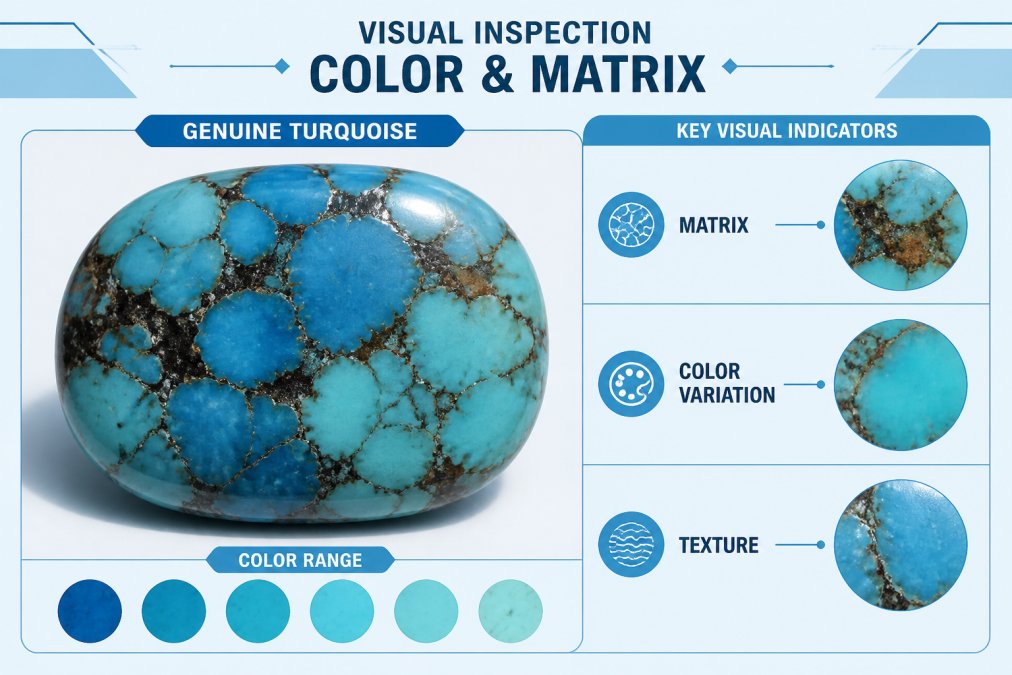
Look for these markers of authenticity:
Natural matrix patterns. Genuine turquoise displays irregular and organic matrix patterns with veins of host rock, usually brown, grey, or black. If the matrix appears printed, painted, or perfectly balanced, it's likely fake. Real matrix is chaotic and unique to each stone.
Color variation. True turquoise shows subtle shifts in tone. One area might be deeper blue while another leans toward green. These transitions are gradual and organic. Imitations often have uniform color saturation because dye sits on the surface.
Waxy luster. Genuine turquoise has a slightly waxy, matte luster. It doesn't shine like glass or plastic. If a piece looks glossy or reflective, it's probably not real.
Translucency test. Hold the stone up to light. Genuine turquoise is opaque; light won't pass through it. Some imitations are slightly translucent or show light at the edges.
Spend time comparing multiple pieces if possible. Visit reputable jewelers and handle both authentic and imitation pieces to train your eye.
How to Test Turquoise with Acetone
The acetone test is one of the most effective non-destructive methods to spot dyed turquoise. If a cotton bud dipped in acetone and rubbed on an inconspicuous part of the stone for 20-30 seconds transfers blue color, the stone is dyed. Genuine turquoise will not release color this way.
What you'll need:
- Acetone (available at most drugstores)
- Cotton swabs or cotton buds
- A small, inconspicuous area on the back or underside of the piece
How to perform the test:
- Apply acetone to a cotton swab. Saturate it fully but not dripping.
- Rub the stone gently. Apply moderate pressure to an inconspicuous area for 20-30 seconds.
- Check the swab. If blue dye transfers to the cotton, the stone is dyed. Genuine turquoise leaves no color transfer.
- Inspect the stone. Look for any discoloration where you rubbed. Real turquoise won't show any change.
This test works because dyed imitations have color applied to the surface or throughout a porous base material. Real turquoise's color is integral to the mineral itself and won't leach out with acetone.
One caveat: stabilized turquoise may show very slight color transfer because of the resin used in stabilization. The transfer will be minimal. If significant color comes off, you're looking at a dyed imitation, not stabilized genuine turquoise.
Stabilized vs Natural Turquoise: Know the Difference
Understanding the difference between stabilized and natural turquoise is critical because market terminology confuses most buyers. Both are genuine turquoise, meaning they contain real turquoise mineral. The difference lies in treatment.
Natural turquoise is untreated stone pulled directly from the mine. It's rare, expensive, and fragile. Natural turquoise is porous and can absorb oils, lotions, and sweat, which can darken or damage the stone over time. Only about 15% of turquoise sold globally is natural and untreated.
Stabilized turquoise is genuine turquoise treated with a clear resin to harden the stone and lock in color. The resin fills the stone's pores, making it more durable and resistant to discoloration. Stabilized turquoise makes up about 95% of the market for "genuine" turquoise and is the industry standard for jewelry because it holds up to daily wear.
Many people assume "stabilized" means "fake." It doesn't. Stabilized turquoise is genuine turquoise chemically enhanced for durability and color. It's different from imitation turquoise, which contains no real turquoise at all.
The key is disclosure. A reputable seller will tell you whether a piece is natural or stabilized. If they claim everything is "100% natural" when selling at bargain prices, they're either lying or uninformed. Natural turquoise commands premium prices, often $50 to $200+ per carat depending on quality and origin.
If you're shopping at Barrels and Bourbon Trading Co, each piece is clearly labeled regarding turquoise type. Our Sterling Silver Sonoran Gold Turquoise Blossom Pendant features genuine Sonoran Gold turquoise set in sterling silver, with each stone's treatment disclosed upfront.

What Is Block Turquoise and Reconstituted Stone
Block turquoise refers to turquoise cut or shaped from larger pieces of raw stone. It's genuine turquoise, typically stabilized, and represents the standard for most turquoise jewelry.
Reconstituted turquoise is turquoise crushed into powder, mixed with a binder (usually epoxy or resin), and pressed into blocks or shapes. It contains real turquoise mineral but has been completely reconstructed. The result is a uniform, consistent product that's cheaper to produce than block turquoise.
Reconstituted turquoise isn't necessarily "fake," but it's lower quality and lower value than block turquoise. A piece made from reconstituted turquoise might cost $20 to $50, while the same design in block turquoise costs $100 to $300.
The problem: sellers sometimes misrepresent reconstituted turquoise as natural or block turquoise to justify higher prices. Look for product descriptions that specify "block turquoise" or "natural turquoise." If the description is vague, ask directly whether it's block or reconstituted.
Price is your clue. If a turquoise piece is priced suspiciously low, $15 for a substantial pendant, for example, it's likely reconstituted or imitation.
Surface Texture, Weight, and the Feel Test
Your tactile senses reveal information that visual inspection alone cannot. Genuine turquoise feels cool and solid to the touch, with moderate density. Plastic or resin imitations often feel warmer, lighter, or hollow.
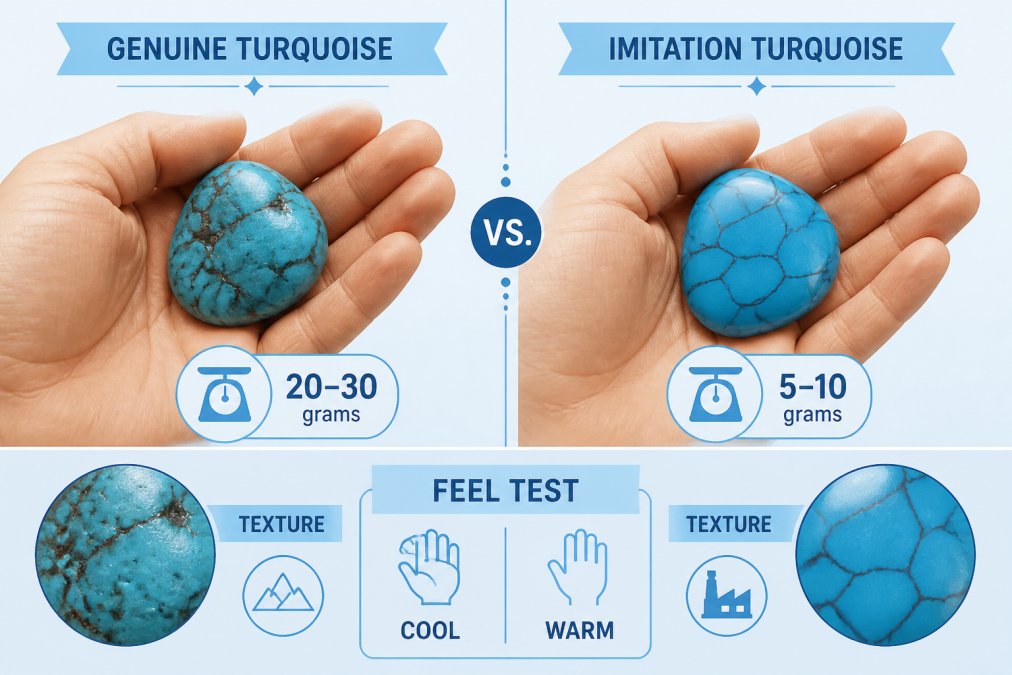
The weight test. Hold a turquoise piece in your palm. Genuine turquoise has substantial heft for its size. Plastic imitations feel noticeably lighter. If a large pendant feels insubstantial or hollow, it's likely fake.
The temperature test. Genuine turquoise feels cool to the touch, even in a warm room. Plastic and resin feel closer to room temperature or warm up quickly in your hand.
The texture test. Run your finger over the stone's surface. Genuine turquoise has a slightly gritty or matte texture. Plastic feels smooth and uniform.
The sound test. Gently tap the piece against your tooth. Genuine turquoise produces a dull, solid sound. Plastic produces a hollow or tinny sound.
These tactile tests work because imitation materials have fundamentally different physical properties than turquoise.
Identifying Plastic and Resin Imitations
Plastic and resin imitations are the most common fakes you'll encounter. They're cheap to produce, easy to mold, and can be dyed to look convincingly like turquoise. Fortunately, they're also the easiest to identify once you know what to look for.
Visual red flags: Plastic imitations often have a glossy, uniform appearance with flat color lacking the subtle variations of genuine turquoise. Under magnification, synthetic stones appear uniform with repeating patterns rarely found in nature. Real turquoise shows uneven grain, mineral lines, and small pits.
The weight difference. Plastic is significantly lighter than turquoise. A plastic pendant that looks substantial will feel insubstantial in your hand.
The hardness test. Plastic scratches easily with a fingernail or coin. Even light pressure leaves visible marks. Genuine turquoise resists scratching.
The heat test. Hold the stone near (not touching) a flame for a few seconds. Plastic will emit a chemical smell and may melt or warp. Genuine turquoise won't smell or change. Only test on pieces you're certain are imitation.
Most plastic imitations are obvious once you handle multiple pieces. Your eye and hands will learn the difference quickly.
Spotting fake turquoise jewelry protects both your wallet and your integrity as a collector. The methods covered here, scratch tests, visual inspection, acetone testing, and tactile evaluation, give you the tools to make confident purchases. When you're ready to invest in authentic pieces, choose retailers committed to transparency and quality. At Barrels and Bourbon Trading Co, every turquoise piece is authenticated and clearly labeled. Our Sterling Silver Kingman Turquoise Dangle Earrings and Mini Inlay Earrings feature genuine, hand-selected stones with artist hallmarks and sterling silver construction. Start your collection with confidence.

| Test Method | What It Detects | Destructive | Effectiveness |
|---|---|---|---|
| Scratch Test | Soft imitations (magnesite, howlite) | Minimal | High for soft stones |
| Visual Inspection | Dyed imitations, uniform color | None | High with experience |
| Acetone Test | Dyed surface color | None | Very high |
| Weight & Feel | Plastic imitations | None | High for lightweight fakes |
| Hardness Test | Plastic, soft materials | Minimal | High |
| Magnification | Synthetic patterns, grain | None | High with loupe |
=== FAQ ANSWERS (audit these too, same rules) ===
[1] Q: How can I test for real turquoise at home? A: Start with the scratch test: real turquoise has a Mohs hardness of 5 to 6, so it won't scratch with a fingernail or coin. Softer imitations like magnesite scratch easily. Next, inspect the color for uniformity, genuine turquoise shows natural mottling and color shifts, while fakes appear flat and uniformly saturated. Finally, perform the acetone test: dip a cotton bud in acetone and rub an inconspicuous area for 20-30 seconds. If color transfers, it's dyed. Genuine turquoise won't release color this way.
[2] Q: What is the difference between stabilized vs natural turquoise? A: Stabilized turquoise is genuine turquoise that has been chemically enhanced with resin to improve durability and color. It's not fake, it's real turquoise that's been treated. Natural turquoise is untreated stone straight from the mine. Stabilized turquoise makes up about 95% of the market and is perfectly acceptable if the seller discloses it. The key difference: stabilized turquoise lasts longer in jewelry because the resin fills tiny pores, but both are genuine mineral.
[3] Q: What does fake turquoise look like compared to the real thing? A: Fake turquoise, especially dyed howlite or magnesite, appears uniformly colored with a flat, painted appearance. Real turquoise displays subtle mottling, lighter and darker patches, and natural color shifts depending on light angle. Genuine stones show organic, irregular matrix patterns (veins of host rock in brown, grey, or black). If the matrix looks printed, painted, or perfectly balanced and repeated, it's likely fake. Under magnification, real turquoise shows uneven grain and mineral lines; synthetics appear uniform with repeating patterns.
[4] Q: Why should I buy from Barrels and Bourbon Trading Co instead of cheaper alternatives? A: Our turquoise jewelry is handcrafted by Native American artisans and features genuine, high-quality stones with proper hallmarking and artist signatures. Each piece is one of a kind, like our Sterling Silver Kingman Turquoise Half Cluster Earrings ($400) or Sonoran Gold Turquoise Blossom Pendant ($275). We source from reputable mines and disclose stone treatment. When you pay more, you're getting authentic craftsmanship, verified materials, and pieces that hold their value, not mass-produced imitations that lose appeal quickly.
Frequently Asked Questions
Q: How can I test for real turquoise at home?
A: Start with the scratch test: real turquoise has a Mohs hardness of 5 to 6, so it won't scratch with a fingernail or coin. Softer imitations like magnesite scratch easily. Next, inspect the color for uniformity, genuine turquoise shows natural mottling and color shifts, while fakes appear flat and uniformly saturated. Finally, perform the acetone test: dip a cotton bud in acetone and rub an inconspicuous area for 20-30 seconds. If color transfers, it's dyed. Genuine turquoise won't release color this way.
Q: What is the difference between stabilized vs natural turquoise?
A: Stabilized turquoise is genuine turquoise that has been chemically enhanced with resin to improve durability and color. It's not fake, it's real turquoise that's been treated. Natural turquoise is untreated stone straight from the mine. Stabilized turquoise makes up about 95% of the market and is perfectly acceptable if the seller discloses it. The key difference: stabilized turquoise lasts longer in jewelry because the resin fills tiny pores, but both are genuine mineral.
Q: What does fake turquoise look like compared to the real thing?
A: Fake turquoise, especially dyed howlite or magnesite, appears uniformly colored with a flat, painted appearance. Real turquoise displays subtle mottling, lighter and darker patches, and natural color shifts depending on light angle. Genuine stones show organic, irregular matrix patterns (veins of host rock in brown, grey, or black). If the matrix looks printed, painted, or perfectly balanced and repeated, it's likely fake. Under magnification, real turquoise shows uneven grain and mineral lines; synthetics appear uniform with repeating patterns.
Q: Why should I buy from Barrels and Bourbon Trading Co instead of cheaper alternatives?
A: Our turquoise jewelry is handcrafted by Native American artisans and features genuine, high-quality stones with proper hallmarking and artist signatures. Each piece is one of a kind, like our Sterling Silver Kingman Turquoise Half Cluster Earrings ($400) or Sonoran Gold Turquoise Blossom Pendant ($275). We source from reputable mines and disclose stone treatment. When you pay more, you're getting authentic craftsmanship, verified materials, and pieces that hold their value, not mass-produced imitations that lose appeal quickly.
This article was written using GrandRanker