Table of Contents
- What Stabilized Turquoise Jewelry Actually Means
- Stabilized vs. Natural Turquoise: Key Differences
- Is Stabilized Turquoise Real? Clearing Up the Myths
- How to Identify Stabilized Turquoise: What You Can and Can't Tell
- Turquoise Jewelry Care: Keeping Stabilized Stones Looking Good
- How Treatment Affects Value, Provenance, and Buying Decisions
- Which Jewelry Types Suit Stabilized Turquoise Best
- Conclusion
- Frequently Asked Questions
Last Updated: October 5, 2026
What Stabilized Turquoise Jewelry Actually Means
Stabilized turquoise jewelry is made with turquoise treated with a clear resin to harden the stone so it survives daily wear without cracking or fading. The treatment does not change the stone's identity: it is still real turquoise, just reinforced.
Here is the short version: most turquoise on the jewelry market is stabilized because natural, untreated turquoise is often too soft or porous to hold up in a ring or bracelet. According to Fire Mountain Gems' complete guide to turquoise, most turquoise sold for jewelry-making is stabilized, and epoxy resin is one treatment used to increase hardness and enhance color.
Stabilization is a durability treatment, not a trick.
How the Stabilization Process Works
Stabilization pulls a liquid resin into the stone's pores, then cures it so the plastic hardens inside the turquoise. The stone keeps its natural color and matrix; it simply becomes tougher.
The steps are straightforward:
- Cut rough turquoise into slabs or preforms
- Dry the material to remove moisture
- Place the stone in a vacuum chamber and pull air out of the pores
- Introduce the stabilizing solution so resin absorbs into the stone
- Apply pressure to push resin deeper
- Cure the resin, then cut and polish the hardened stone
The vacuum step matters most: a porous stone full of air will not accept resin evenly, so the vacuum replaces that air with the stabilizing solution.
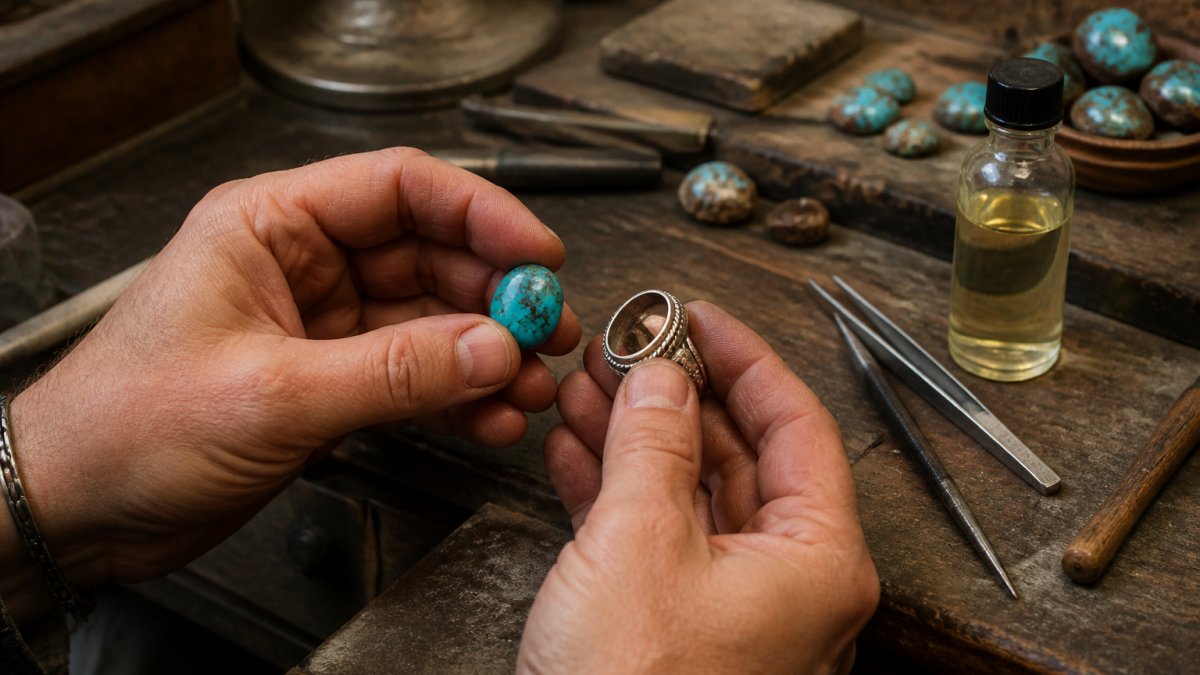
Stabilized vs. Natural Turquoise: Key Differences
The core difference is hardness and porosity, not authenticity. Natural turquoise comes out of the ground as-is; stabilized turquoise is reinforced with resin so it can take everyday wear.
| Factor | Natural Turquoise | Stabilized Turquoise |
|---|---|---|
| Hardness | Varies, often soft | Consistently harder |
| Porosity | High, absorbs oils | Sealed by resin |
| Color over time | Can shift or darken | Color preserved |
| Best use | Collector pieces, light wear | Rings, bracelets, daily wear |
| Price | Higher for gem-grade | More accessible |
Hardness, Porosity, and Color: What Changes
Hardness improves because the resin fills the spaces between mineral grains, turning a soft material that would crumble under a bezel set into a stone you can wear every day.
Porosity drops for the same reason. Untreated turquoise soaks up skin oils, lotions, and sunscreen, and those absorbed substances turn a bright blue stone muddy over a few years.
Color itself is not usually altered by stabilization.
Is Stabilized Turquoise Real? Clearing Up the Myths
Yes, stabilized turquoise is real turquoise. The stone is genuine; the resin only reinforces it. This is the point most buyers get wrong.
Durango Silver calls the idea that stones are stabilized to deceive buyers a myth, arguing that stabilization exists to improve durability and preserve color. A stabilized stone is a practical stone, not a counterfeit.
The confusion comes from terminology. Four things get lumped together that should not be:
- Stabilized: real turquoise, reinforced with resin for hardness
- Dyed: real or low-grade turquoise with added color
- Reconstituted: turquoise dust and fragments bonded together into blocks
- Imitation: materials like howlite or plastic dyed to look like turquoise
Only the first is what we are talking about here.
How to Identify Stabilized Turquoise: What You Can and Can't Tell
Most stabilized turquoise cannot be identified by eye alone. Honest identification relies on disclosure, testing, and a few visual clues that suggest treatment without proving it.
What you can sometimes notice:
- Resin can give a stone a slightly waxy or plastic-like surface luster
- Color that looks uniformly flat, with no variation across the stone, can hint at treatment or dyeing
- A very hard, dense feel in a stone that should be soft is a clue, not a verdict
- A stone that rings slightly when tapped can suggest resin filling, though this is unreliable
You cannot look at a cabochon and declare it stabilized with certainty; the resin sits inside the stone. A jeweler or gem lab with the right equipment can test for it, but a casual glance cannot. Appearance alone is not proof, and even experienced dealers rely on disclosure and documentation more than visual inspection.
The Treatment Taxonomy Buyers Confuse
Four categories get lumped together that should not be. Knowing the difference tells you what you are actually buying:
- Stabilized: real turquoise, reinforced with clear resin for hardness. The stone is genuine; the resin is a durability treatment.
- Dyed: real or low-grade turquoise with added color. The stone may be genuine but the color is not natural.
- Reconstituted: turquoise dust and fragments bonded together into blocks. The material is turquoise, but the stone is composite, not a single natural piece.
- Imitation: materials like howlite, magnesite, or plastic dyed to look like turquoise. This is not turquoise at all.
Only the first is what we are talking about here. Confusing these categories is the most common and most expensive mistake in turquoise buying.
Disclosure and Labeling: What Sellers Must Tell You
In the United States, the FTC's guidance on jewelry advertising and marketing requires sellers to disclose treatment information that affects value, and stabilization is exactly that kind of treatment. A seller who knows a stone is stabilized should say so.
Practical takeaway: ask directly. "Is this stone stabilized, natural, reconstituted, or imitation? Is the color natural or dyed?" A straight answer is a good sign. Evasion is not.
When to Get a Professional Assessment
If you are spending collector-level money on a natural, untreated stone, or a seller's claims do not match what you see, a professional assessment is worth the cost. Gem labs can test for resin, dye, and stone identity using equipment no buyer has at home. For everyday stabilized jewelry that testing is usually unnecessary; for a high-value natural stone, it is the only way to know what you own.
Turquoise Jewelry Care: Keeping Stabilized Stones Looking Good
Stabilized turquoise needs less babying than untreated stone, but it is not indestructible. The resin handles oils and moisture; it does not handle heat, chemicals, or impact.
Why Stabilized Stones Need Different Care
Untreated turquoise is porous, so it absorbs skin oils, lotions, and sunscreen, which turns a bright blue stone muddy over time. Stabilized turquoise has those pores sealed with resin, so it resists absorption far better. But the resin has limits: prolonged heat can soften or degrade it, and harsh chemicals can break it down or discolor it. Stabilized turquoise is more forgiving day to day but still vulnerable to heat and chemicals.
A Simple Care Routine
- Put jewelry on last, after lotion, perfume, and hairspray have dried
- Wipe stones with a soft dry cloth after wear
- Keep pieces out of prolonged direct sun and away from hot cars
- Remove rings and bracelets before dishes, gardening, or ranch work
- Store pieces separately so metal does not scratch the stone
- Avoid ultrasonic cleaners and steam cleaners on turquoise, stabilized or not
- Avoid household cleaners, chlorine, and acetone-based nail polish remover
Sterling silver settings can be polished with a silver cloth, but keep polishing compounds off the stone itself. If a stabilized stone does become dull, a soft dry cloth is the safest first step; abrasive polishes can scratch the resin surface.
Heat, Chemicals, and Impact: What Actually Damages Stabilized Stones
The three real threats to stabilized turquoise are heat, chemicals, and impact. Heat can soften the resin and cause it to discolor or lose its bond with the stone. Chemicals, especially chlorine, ammonia, and acetone, can break down the resin or leach color. Impact can crack the stone even though the resin makes it harder than untreated material.
Storage and Long-Term Care
Store stabilized turquoise pieces separately in a soft pouch or lined box so metal does not scratch the stone, and keep them out of prolonged direct sunlight, since UV exposure can fade both natural color and resin over time. Check settings periodically; a loose stone is more likely to crack from impact than a properly seated one.
How Treatment Affects Value, Provenance, and Buying Decisions
Stabilization generally lowers the price of a stone compared with gem-grade natural turquoise of the same color and size, because treated material is more abundant and less collectible.
Here is how we would think about it:
- Buying to wear: Stabilized turquoise is the better choice. It survives rings, bracelets, and daily life.
- Buying to collect: Natural, untreated turquoise with strong color and clean matrix commands a premium and holds provenance value.
- Buying a gift: Stabilized stones give you more design options and better durability at a friendlier price point.
Provenance matters most for collector-grade natural stones, where mine origin and documentation affect value.
At Barrels and Bourbon Trading Co, our sterling silver and turquoise pieces are chosen for exactly this reason. We want jewelry that holds up on a working ranch and still looks right at a family gathering.
Which Jewelry Types Suit Stabilized Turquoise Best
Stabilized turquoise suits any jewelry that takes impact.
Necklaces and earrings take less abuse, so they can carry stabilized or natural stones depending on your budget.
For kids' jewelry and everyday western pieces, stabilized is the practical answer. It resists the oils, bumps, and occasional drops that come with real life.
If you are outfitting a whole family, mixing stabilized pieces for daily wear with a natural statement piece or two gives you durability where you need it and a collectible where it counts.
Conclusion
The real challenge with turquoise is not spotting treatment; it is knowing which stone fits how you actually live. Stabilized turquoise gives you genuine stone, real color, and the durability to wear it without worry.
Barrels and Bourbon Trading Co carries sterling silver and turquoise jewelry built for that kind of life, alongside western-inspired apparel, footwear, and accessories for the whole family.
Get started with Barrels and Bourbon Trading Co and find a piece you can wear every day without second-guessing it.
Frequently Asked Questions
Is stabilized turquoise real turquoise?
Yes. Stabilized turquoise is real turquoise that has been treated with epoxy resin to increase hardness and preserve color. The stone itself is genuine turquoise, just softer material that has been hardened for jewelry use. It is not the same as imitation, reconstituted, or dyed block material. Fire Mountain Gems notes that most turquoise sold for jewelry-making is stabilized, which tells you how common the treatment is across the market.
Is stabilized turquoise less valuable than natural turquoise?
Stabilized turquoise generally sells for less than high-grade natural turquoise, but that is not because it is fake. The price difference comes from rarity. Natural, untreated turquoise that is hard enough to cut and polish without treatment is scarce. Stabilized stones let jewelers use softer, more porous material that would otherwise crumble. For everyday wear, stabilized turquoise often delivers better durability at a more accessible price point.
How can you tell if turquoise has been stabilized?
Visual identification is limited. Stabilized turquoise usually has a consistent color and fewer visible pores, while natural turquoise often shows more matrix variation and surface texture. A gemologist or reputable jeweler can confirm treatment through lab testing. The most reliable signal is disclosure: ask the seller directly whether the stone is stabilized, natural, or treated. Reputable sellers label treatments clearly.
How should you care for stabilized turquoise jewelry?
Keep stabilized turquoise away from harsh chemicals, perfumes, and prolonged sunlight. Wipe stones with a soft dry cloth after wearing and store pieces separately to avoid scratches. Remove rings before washing hands, swimming, or working with cleaning products. Sterling silver settings can be polished with a silver cloth, but avoid dipping the whole piece in liquid cleaner because it can affect the resin over time.